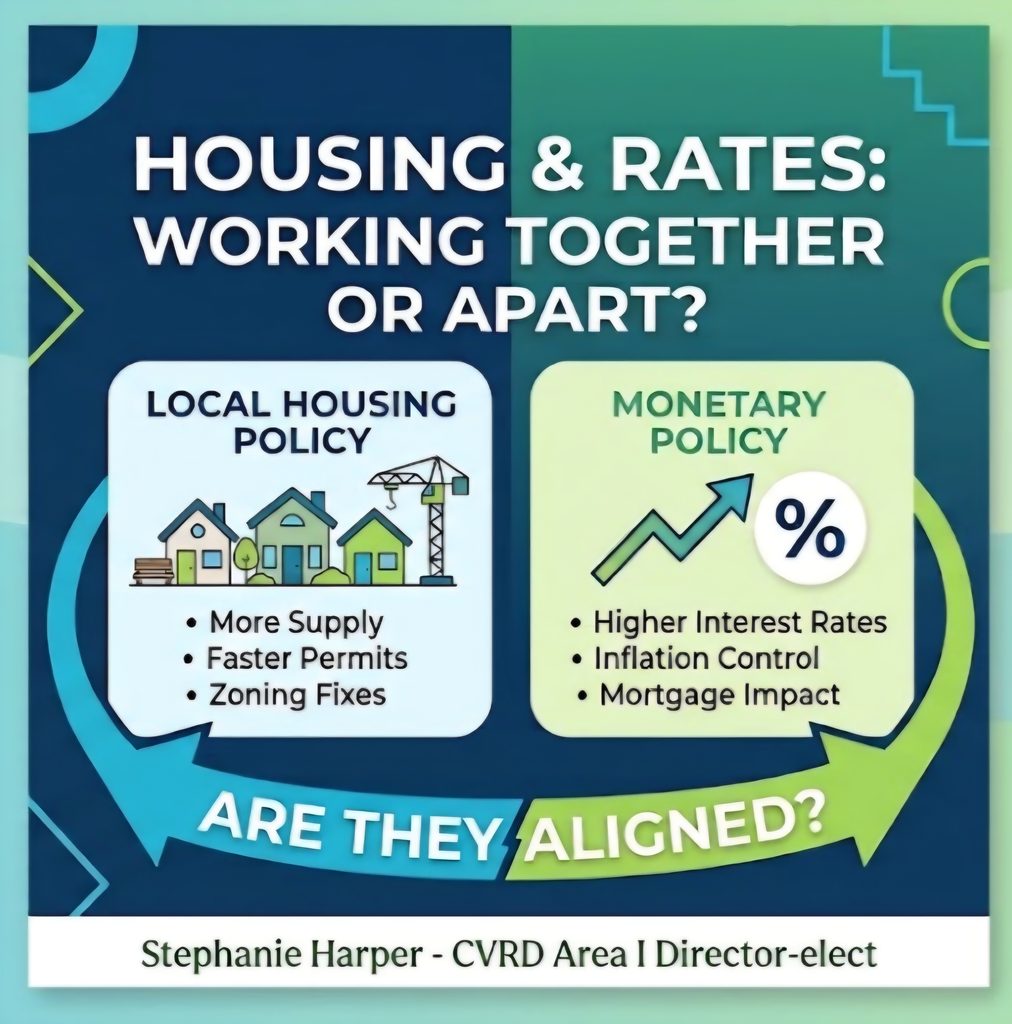
At what point does using high interest rates to fight inflation actually make Canada’s housing affordability problem worse? Is it time to rethink how we finance primary residences in Canada?
I woke up this morning thinking about how we improve access to housing in the Cowichan Valley Regional District, as we’ve experienced a steady decline in new home permits over the past five years.
Local government needs to use the tools we have: faster approvals, cleaner policy processes, less unnecessary regulation and reasonable standards. We need to make it easier to build a basic home.But building more is only part of the answer. We need houses people can actually afford.
The benchmark price of a single-family home in the Cowichan Valley is around $779,000. Price is only part of affordability. The cost of financing matters too.Take a $700,000 mortgage with a 25-year amortization. At 3%, the payment is about $3,300 a month. At 5%, it’s about $4,070. That’s roughly $760 more every month, or more than $9,000 a year, coming out of a family’s after-tax income.
The mortgage didn’t get bigger. The house didn’t get bigger or better, and the lot didn’t improve. The cost of borrowing the money changed.
That affects first-time buyers, families and seniors renewing their mortgages, people trying to move and builders trying to finance new homes.
Local government can work on housing affordability through zoning, permits, regulation, and taxation. At the same time, monetary policy uses interest rates to control inflation, directly affecting what families pay for their mortgages and what builders pay to finance new housing.
The Bank of Canada’s own research found that both supply and demand contributed to the inflation surge following the pandemic, with supply pressures accounting for the larger share.
Higher interest rates can reduce demand, but they can’t remove a tariff, fix an international supply problem or control many of the outside pressures and geopolitical events affecting prices in Canada.
So we need to ask a bigger question: Are our housing policies and our monetary policy working together, or against each other?Every level of government needs to work on the things within its control but collaboratively for a successful outcome.Because at the end of the day, we need homes people can actually afford to live in.
#HousingChallenges #localgovernment #Canada #CowichanValley #monetarypolicy #affordabilitymatters