I’ve spent the last four years involved in this process through the Advisory Planning Commission — reviewing policies, listening to the community, and trying to help shape a better outcome.
Here’s what I’m seeing.
People aren’t pushing back on planning — they’re pushing back on how it’s being done, and the real impacts it’s having on their lives.
And it’s not just Cowichan. The same patterns are showing up across Vancouver Island.
Here’s what I see — and some ideas for a better path forward.
CVRD — From Harmonized to Modernized
Here in the Cowichan Valley, the CVRD moved from a Harmonized OCP (HOCP) — adopted in 2021 — to a Modernized OCP (MOCP) adopted in Nov 2025 with a 6-3 vote, introducing a far more detailed and structured policy framework which was based on a board strategic plan, a Complete Community template and engagement facilitated through years of work by staff and Modus.
The HOCP wasn’t outdated or irrelevant. It was a relatively recent plan, designed to bring consistency across electoral areas while still reflecting the realities of rural communities.
The modernization, however, introduced a significant shift.
That shift brought:
- stronger growth management tools
- expanded environmental policies
- more defined land-use categories
- increased use of Development Permit Areas (DPAs) — adding new layers of approval, cost, and oversight
- a greater standardization of land use across the region, regardless of the unique and important differences in how land is actually used on the ground
And here’s the part we need to be honest about:
We didn’t just go from harmonized to modernized — we went from a workable framework to one that is far more layered, prescriptive, and harder to navigate. That might work in an urban setting, but in rural communities, that level of rigidity doesn’t always fit how people actually live on the land.
And more than that, it assumes a level of uniformity that simply doesn’t exist here.
Cowichan isn’t one landscape — it’s a series of microclimates and land-use realities. If Youbou is getting 100 mm of rain, should people in sunny Cowichan Bay or Mill Bay be required to wear a raincoat?
That’s what this starts to feel like.
A one-size-fits-all approach — layered with additional permitting requirements like DPAs — applied to a region that is anything but uniform.
And importantly, this wasn’t just a public reaction — it showed up within the process itself.
Entire Advisory Planning Commissions (APCs) resigned during the OCP process, citing a lack of meaningful consultation and concern that extensive community input was not being reflected in outcomes.
At the governance level, concerns were raised as well. The ‘Chair’ of the Electoral Services Committee, AREA F elected official Ian Morrison, stepped down from that role as ‘chair’ — doing so during a meeting — to object to the direction of the process and express that his electoral area was being left behind and disproportionately impacted.
👉 This wasn’t just a disagreement — it was a process that became divisive, even among those directly involved in it.
When advisory bodies resign, elected leadership steps back, and communities continue to push back and not be heard — it’s a clear signal that something in the process isn’t working the way it should.
Where This Shows Up: Zoning
Now we’re seeing the real impact.
OCPs set direction — but zoning bylaws and tools like Development Permit Areas (DPAs) are where that direction becomes reality.
And that reality is landing. Across the region, residents are seeing:
- more defined and restrictive permissions
- added layers of regulation
- expanded use of DPAs that introduce additional approvals, timelines, and costs
What once felt abstract is now tangible.
👉 The policies people were concerned about are now shaping what they can actually do on their land.
This Is Hitting Home — And People Are Feeling It
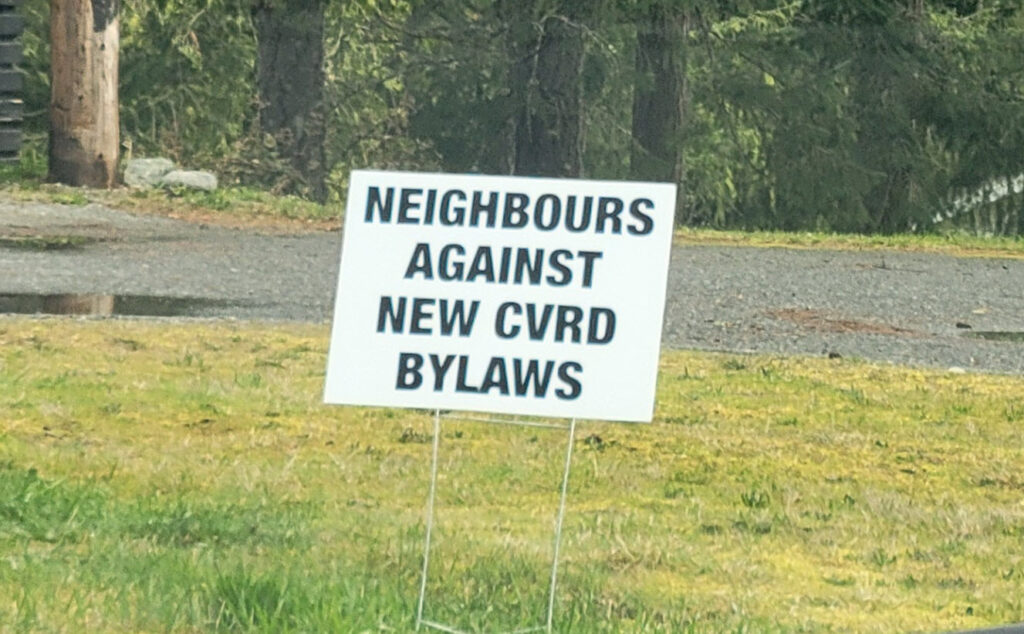
Right now in the Cowichan Valley, people are paying attention in a way we haven’t seen before.
Not because of a document, but because of real-life impact.
As the Comprehensive Zoning Bylaw rolls out, people are starting to see — in real terms — what the Official Community Plan (OCP) actually means for their land, their choices, and their future.
And for many, it’s not what they thought they were signing up for,
👉 This didn’t start with zoning.
It started with the Official Community Plan
And this isn’t just happening here.
There’s a Pattern — Across Communities
When you look beyond the Cowichan Valley, a clear pattern starts to emerge.
In places like Sooke, North Cowichan and North Saanich, communities have gone through similar OCP processes — and faced similar outcomes. And raises many questions and highlights problems that need to be addressed.
Sooke — A Real-Time Example of the Same Divide
In Sooke, the same pattern is playing out in real time.
A new Official Community Plan was approved in December 2025 — on a narrow 4–3 Council vote, highlighting a clear divide not just in the community, but at the decision-making level.
👉 Sooke council approves new OCP in narrow 4-3 vote
At the heart of the debate were expanded Development Permit Areas (DPAs) and concerns over how those policies would impact property rights.
Residents and critics argued that the new rules — particularly for shoreline properties, riparian areas, and steep slopes — would:
- erode property rights
- introduce additional cost and complexity
- create uncertainty in how land could be used
There was also a clear attempt at Council to respond to those concerns. Councillor Kevin Pearson put forward a motion to remove all nine proposed DPAs and reinstate the three from the 2010 OCP — a move aimed at reducing regulatory burden and restoring a more familiar framework. That amendment failed in a 5–2 vote.
Despite significant public input and an effort at Council to scale back the changes, the plan moved forward largely as proposed.
Council ultimately sided with staff recommendations over community concerns, advancing a plan built around familiar priorities:
- environmental protection
- climate targets
- managed growth
And the story didn’t end with adoption — the OCP continues to see backlash as residents begin to understand how those policies are applied in practice.
Once again, the tension shows up in the same place:
👉 how broad policy goals are translated into real, on-the-ground impacts for property owners.
This wasn’t just disagreement — it was a divided process, marked by split votes, failed attempts to adjust course, and a growing perception that community input was outweighed by staff-driven policy direction.
North Cowichan — Where the OCP Conflict Doesn’t End
District of North Cowichan adopted its OCP in 2022 after an extensive engagement process, supported in part by MODUS Planning, Design & Engagement.
It checked all the boxes — public consultation, workshops, stakeholder input.
The plan even acknowledges the importance of rural lifestyle and land-based living.
And yet the tension didn’t go away.
The final Council decision reflected that divide — passing in a 4–3 vote, not a broad consensus. The process was also considered divisive, citing concerns about how it was unfolding.
Community planning continues to be flagged as an area needing improvement. Debates over the Urban Containment Boundary continue. Rural land-use decisions remain contentious.
👉 Adoption didn’t resolve the issue — it carried it forward.
North Saanich — When the Process Becomes Divisive
In District of North Saanich, the OCP review became more than just a planning exercise — it became a dividing line in the community.
From early in the process, organized groups such as Save North Saanich opposed the direction of the review, describing it as flawed and raising concerns about a lack of meaningful consultation and an increased focus on development and density in what is largely a rural area.
At the same time, other residents were advocating for something different — more housing options, particularly for seniors and those looking to age in place, including modest infill and attainable housing.
Both sides believed they reflected the broader community.
And that’s where the process began to fracture.
👉By early 2023, tensions had escalated to the point where MODUS Planning, Design & Engagement — the lead consultant — requested to terminate their contract, with Council accepting that decision shortly after.
The process had broken down to the point where it couldn’t continue as designed.
Even at adoption in 2025, that division hadn’t fully resolved. The final decision came down to a 4–3 Council vote, underscoring how split both the community and its leadership had become.
In what appeared to be a prepared statement following adoption, Councillor Sanjiv Shrivastava referred to the OCP as a “big, beautiful bylaw,” noting he was borrowing “the language from the south.”
In the same remarks, he acknowledged the reality of the divide:
“From the outset, there’s been a faction that has vehemently opposed anything that has development or housing linked to it… and anyone with a slightly contrary view… is considered to be an arch-enemy.”
This wasn’t just a disagreement over policy — it was a process that split the community into opposing camps, each convinced the other did not represent the majority.
The result was a process that lost alignment, eroded trust, and ultimately had to be reset before moving forward.
And North Saanich isn’t an outlier — it’s part of a pattern. Across multiple communities, we’re seeing the same signals: split votes, public pushback, and processes that leave people divided rather than aligned.
The Real Issue: The Gap Between Input and Outcome
Across all of these communities, one thing is consistent.
It’s not that people weren’t engaged — they were. In many cases, extensively.
But instead of building alignment, the process often left communities divided.
Residents speak clearly about protecting rural character, maintaining flexibility, and respecting how they live on the land. But what comes out the other side often reflects a different set of priorities — growth containment, density, environmental overlays, and climate frameworks.
Those goals aren’t inherently wrong.
But when they’re applied using urban-based planning models in rural communities, something gets lost.
👉 People participated — but weren’t truly heard and core organizations were left out of the engagement process
Rural vs Urban — The Core Tension
At the heart of this CVRD OCP and CZB is a fundamental mismatch.
Rural communities are built around land-based living — forestry, agriculture, flexibility, and independence.
Modern planning frameworks are built around compact growth, infrastructure efficiency, and environmental constraints.
Those two realities don’t always align.
And when they’re forced together without enough flexibility, the result is exactly what we’re seeing:
- real impacts in the Cowichan Valley
- backlash in Sooke
- ongoing conflict in North Cowichan
- breakdown and reset in North Saanich
Because people did show up. They participated. They put in the time. But they weren’t truly heard.
And more importantly, some of the core voices weren’t meaningfully included in the process at all.
In a region like the Cowichan Valley — where roughly 78% of the land base is forestry — that matters.
If the people who live and work on that land aren’t fully part of shaping the plan, then you’re not building something grounded in reality – You’re applying a framework onto it.
And that’s where the disconnect happens.
It starts to feel less like meaningful engagement — and more like a checkbox exercise.
Something done to say it happened, not to actually influence the outcome.
There’s a Better Way
We need good planning, stopping it is not an option.
And it’s not about ignoring housing, climate, or environmental responsibility — those are real and they matter.
But the way we’re doing this right now isn’t working.
You can see it everywhere. Split votes, people frustrated, advisory groups stepping away, communities more divided than when we started.
That’s not success. I always come back to the same question — what problem are we actually trying to fix?
Because from where I sit, the MOCP didn’t fix the problem. In a lot of ways, it created many. And that’s what we need to deal with.
The issue isn’t just policy — it’s structure.
We tried to harmonize everything. Then we modernized it. And in doing that, we pushed everything into a one-size-fits-all framework across communities that are completely different from each other.
Cowichan isn’t one place. It’s a mix of landscapes, economies, and ways of living.
Trying to force that into one system doesn’t just make it hard to get agreement — it makes it impractical. And despite being sold as simpler, it’s actually the opposite. It’s harder to navigate, more layered, more restrictive, and it’s creating more issues than it solves.
So what do we do instead?
We step back. We stop trying to force alignment where it doesn’t exist.
Maybe the answer is breaking things back down into something that actually reflects how people live here. South Cowichan. West Cowichan, Agri Communities, Group areas that actually share similar needs and values.
Or maybe the answer is simpler than that.
The Harmonized OCP from 2021 wasn’t broken. It worked. Maybe we stick with that while we take the time to figure out how to move forward properly.
Because right now, what we’ve built is division. Rural vs urban. Policy vs people. Community vs process.
That’s not sustainable or OKAY- we can BE BETTER.
We need to build something different. A bridge. Something that actually brings people together. Something that respects how people live on the land, recognizes the differences across the region, and still gives us a clear path forward.
I believe there is a BETTER WAY
Not by forcing everything into one model, but by recognizing that different places need different approaches.
Not by adding more layers, but by making things clearer and more workable for the people it represents. Planning should be efficient and focused on the community — not extending into areas it doesn’t have jurisdiction over, and not creating more work for the system itself. It should be creating opportunities and supporting jobs in the community, not adding processes that only grow the bureaucracy meant to serve it.
👉 A system should exist to serve the community it represents— not the other way around.
And not by dividing communities, but by building something people can actually stand behind.
Right now, people aren’t pushing back on planning — they’re pushing back on how it’s being done, and the path it’s putting them on.